

I have been watching the AI trade since it began, and something has shifted under the surface.
The conversation is still dominated by semiconductors — by NVIDIA earnings calls, AMD product launches, and who has the fastest chip.
But the money is telling a different story. And the numbers behind it are large enough to change how you think about positioning in this market.
For example: A company that makes cooling systems for data centers has outperformed NVIDIA by a ratio of 4 to 1 over the past six months.
Vertiv Holdings returned 94% vs NVIDIA’s 14.89% year to date (as of 5/28/26). Is the market starting to refocus its AI trade on infrastructure over tech?
Don’t Ignore the Buildout
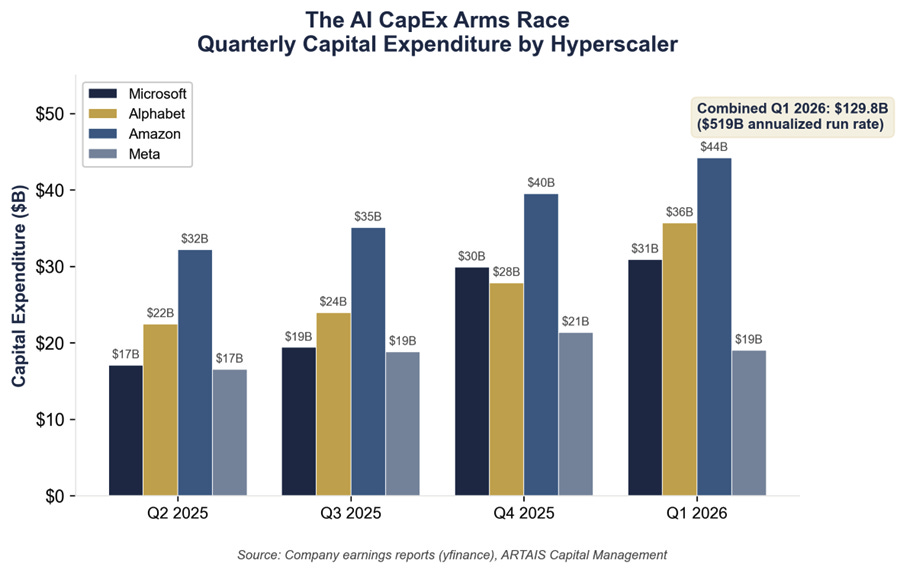
The five largest hyperscalers — Amazon, Alphabet, Microsoft, Meta, and Oracle — are guiding toward a combined $635 billion to $690 billion in capital expenditure for 2026.
Amazon alone is projecting $200 billion. Alphabet is guiding $175 billion to $185 billion. Meta targets $115 billion to $135 billion. Microsoft is tracking toward $120 billion or more. Oracle is targeting $50 billion.
These are not speculative projections. These are company-issued guidance numbers from earnings calls.
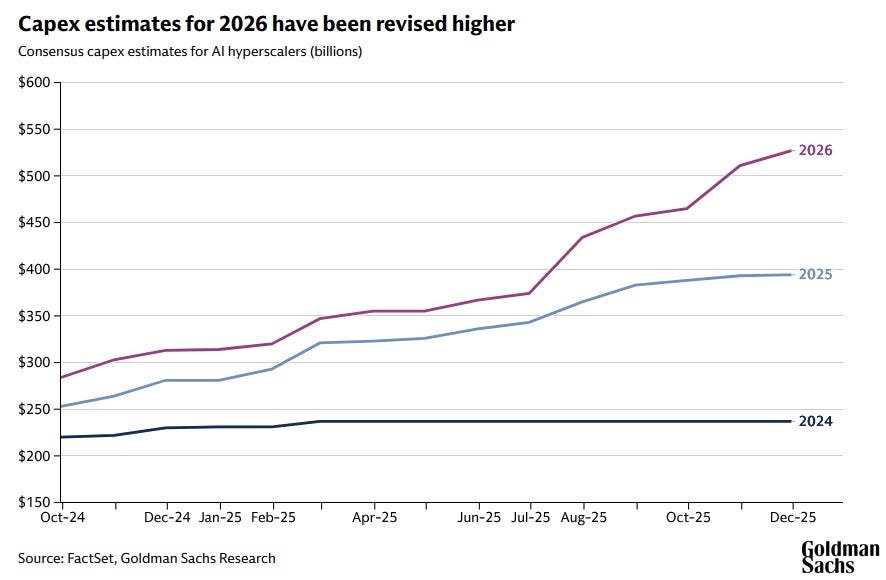
Goldman Sachs estimates AI-focused companies may invest more than $500 billion in infrastructure in 2026 alone. Since that estimate was published, the number has only grown.
The acceleration is staggering:
• 2024: ~$250 billion in combined hyperscaler capex
• 2025: ~$400 billion — the largest single-year step-up in corporate history
• 2026: $635–$690 billion guided — another 60%+ increase
Here is what most semiconductor investors are not thinking about: only about 25% of that spending goes to chips. The other 75% goes to the physical infrastructure — data centers, power systems, cooling equipment, networking hardware, and land.
The GPU is the brain. The data center is the body. And the body costs far more to build.
Source: Goldman Sachs, “Why AI Companies May Invest More than $500 Billion in 2026,” January 2026; Futurum Group, “AI Capex 2026: The $690B Infrastructure Sprint”; Company earnings guidance, Q4 2025 and Q1 2026 earnings calls.
