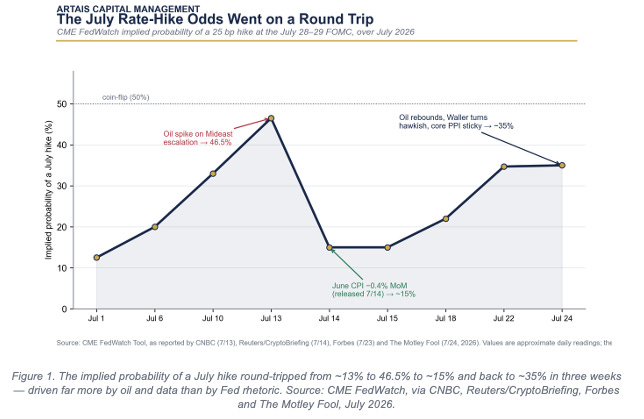
Next week is the July 28–29 FOMC meeting, and the market is doing something it hasn’t done in a while, pricing in a real chance the Fed raises rates instead of cutting or holding.
Currently, the CME’s FedWatch tool puts the odds of a 25-basis-point hike at roughly 35%. While the odds are still low, the back and forth is what I am focusing on.
(Current ARTAIS clients, please reach out to me for a free paid subscription)
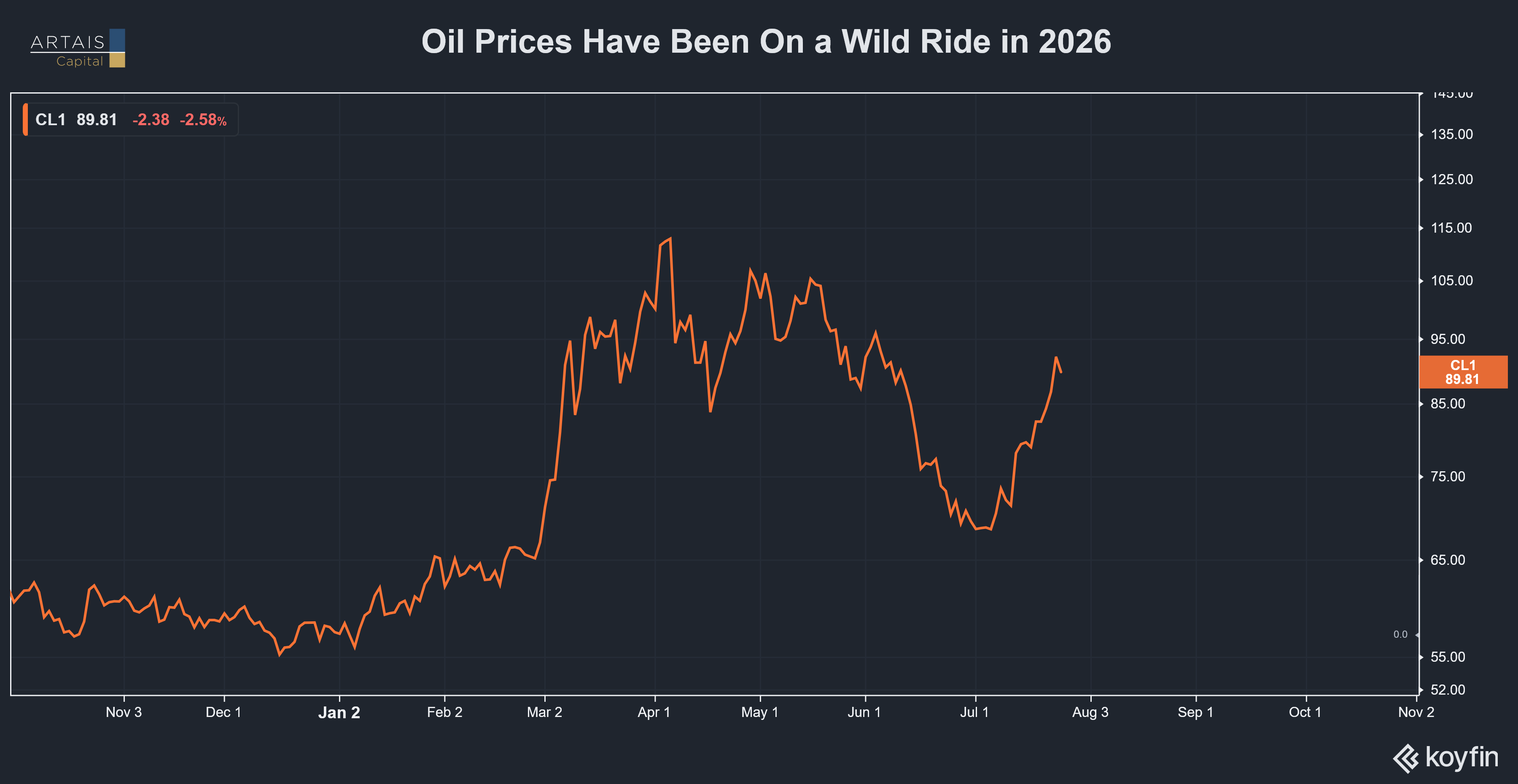
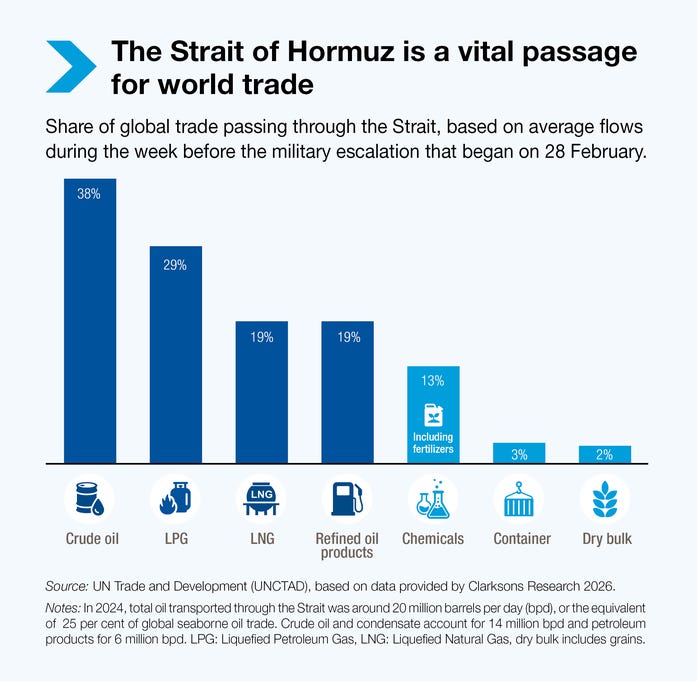
In mid June, the U.S. and Iran reached a preliminary agreement to reopen the Strait of Hormuz for shipping and extend the ceasefire. Oil prices dropped on this news.
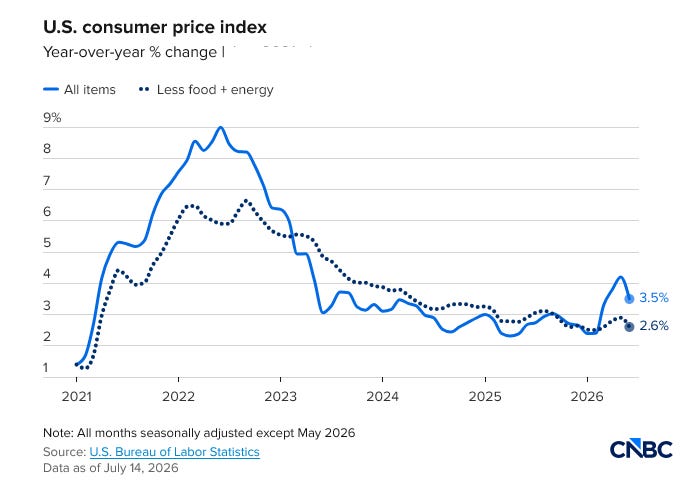
Because of this, the inflation data showed that inflation was starting to cool.
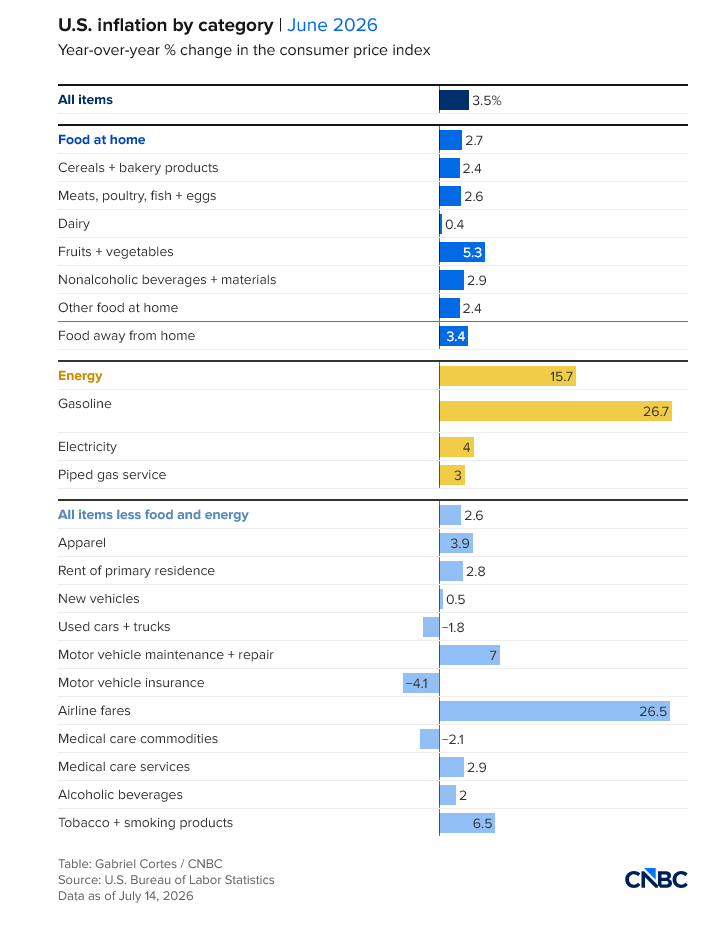
For example, if we strip out food and energy costs, the CPI (consumer price index) has dropped to 2.6% and is heading towards the Fed’s stated target rate of 2%:
The general consensus became that higher oil prices during the conflict were temporarily pushing the data higher:
So why are we even talking about raising rates right now?
Simply, energy and food.
Rising gas prices and food costs are impacting the consumer, which means they have less money to spend.
Since the US is a consumer-based economy, this means less profit for non-energy and non-food companies. Which can translate into layoffs and less jobs.
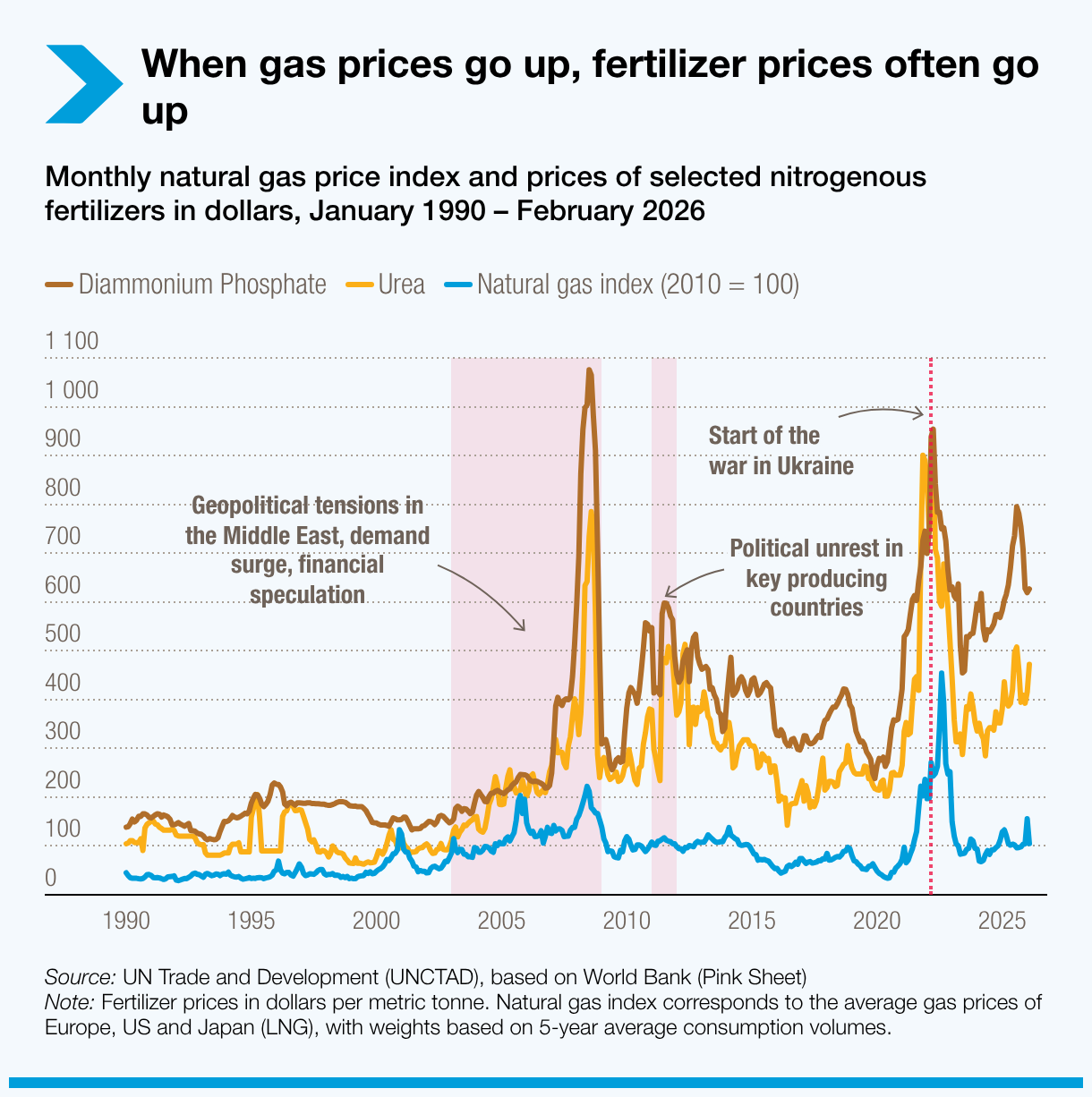
In addition, the closure of the Strait of Hormuz impacts the transportation of non-oil necessities like fertilizer.
And historically, when gas prices rise, so does the price of fertilizer, and therefore food costs rise:
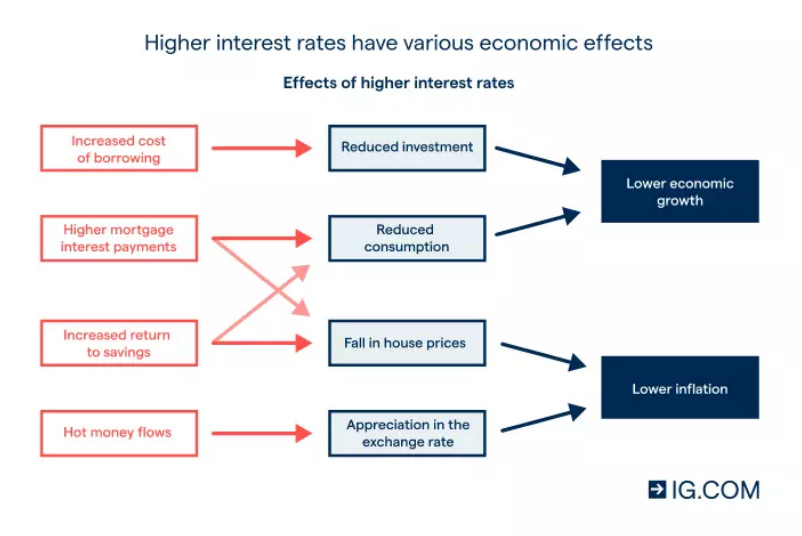
But if the Fed tightens, this can also slow down the economy by raising borrowing costs and making expansion more difficult.
So the Fed, in my opinion, is stuck.
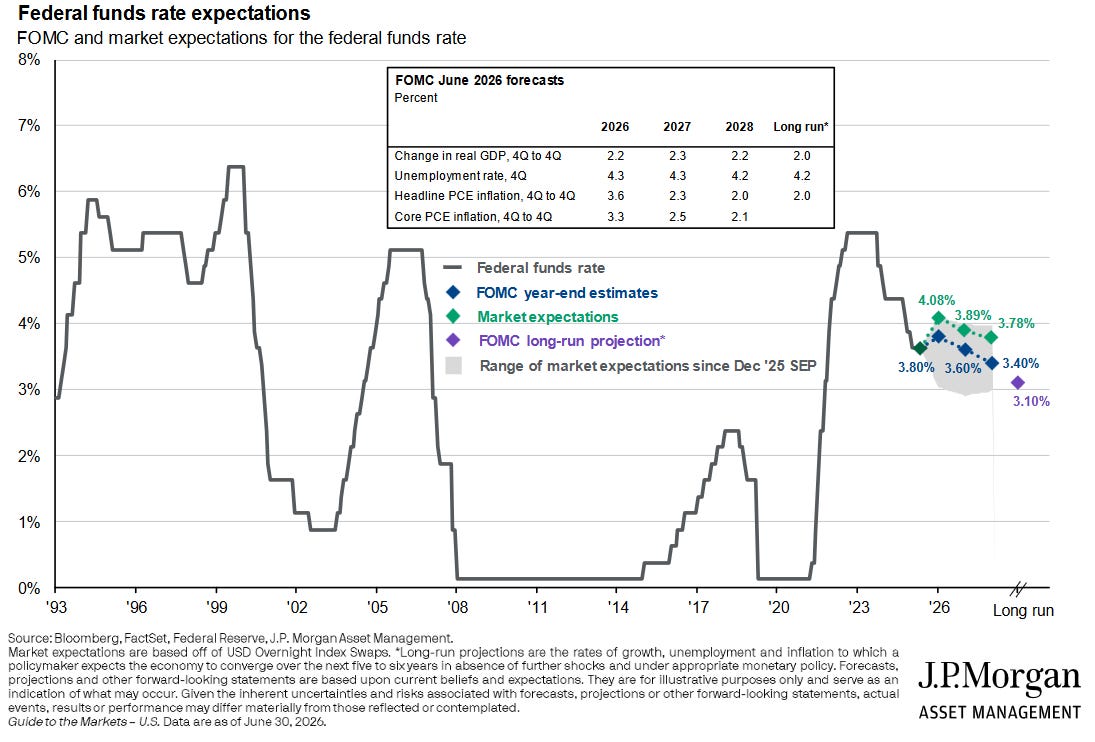
In fact, if we look at the expectation for future interest rate levels, we can see the Fed “flip-flopping” back and forth. (Yes, flip-flopping is my technical term for this):
The plots in the above chart show the Fed raising rates in 2026, then immediately dropping rates to a level lower than what they currently are.
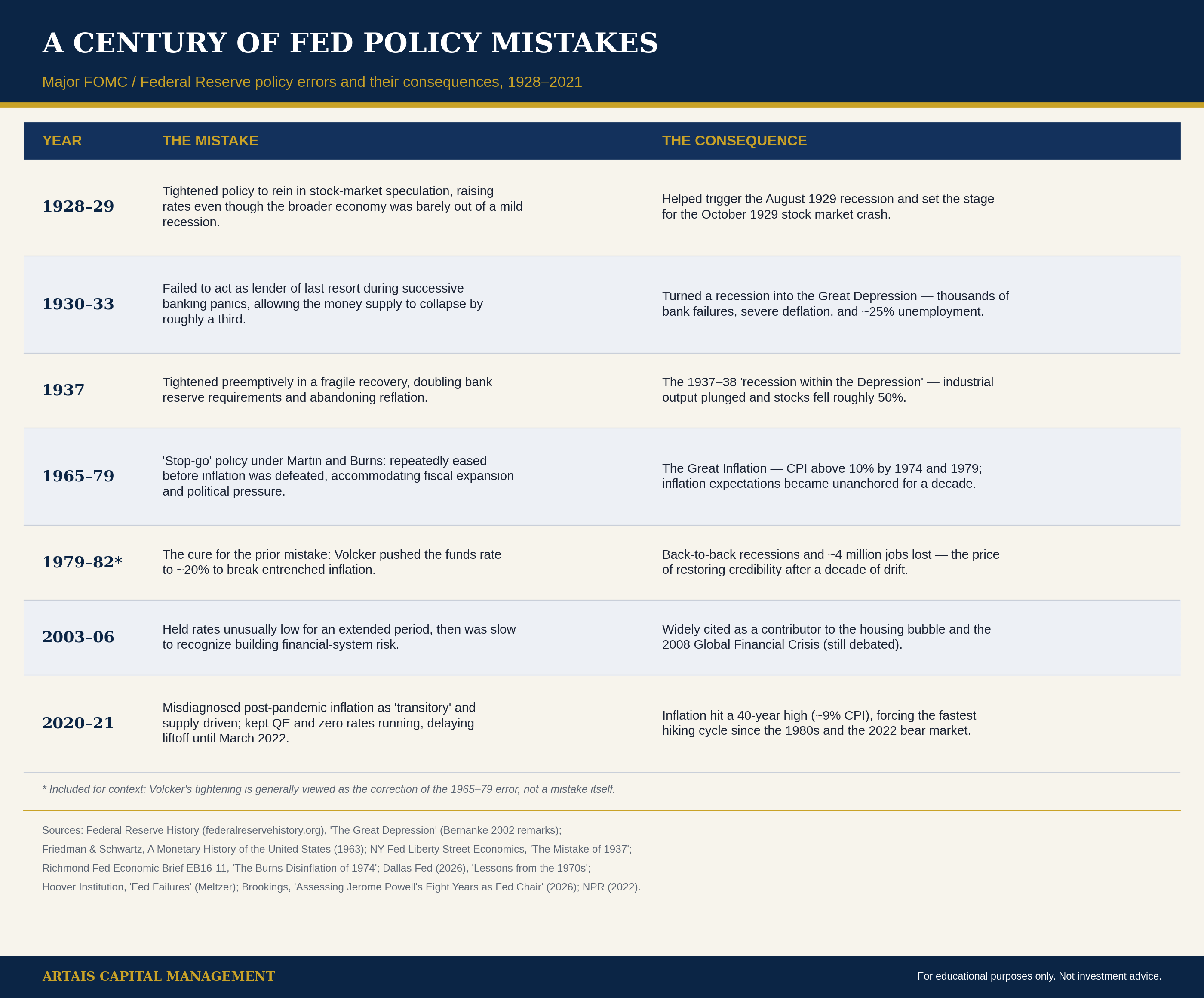
As any long-time investor will tell you, the Fed has historically waited too long, and sometimes overreacts, on its moves. Most recently, calling inflation transitory in 2021 and 2022 and failing to take action.
My base case remains that the Fed should not raise rates, because they have proven in the past to not be nimble enough for the “flip-flop” scenario.
Especially if they think they can time geopolitical events, like the war in Iran.
(Current ARTAIS clients, please reach out to me for a free paid subscription)
DISCLAIMER
This article is published by John Rothe, CMT, principal of ARTAIS Capital Management, LLC (“ARTAIS Capital”), a registered investment advisor offering advisory services in registered states and in other jurisdictions where exempt. Registration does not imply a certain level of skill or training.
The opinions expressed in this newsletter are for informational and educational purposes only and do not constitute investment advice, a recommendation to buy or sell any security, or an offer to provide investment advisory services. All investments involve risk, including the possible loss of principal.
Any references to past performance, market data, or historical patterns are not indicative of future results. Forward-looking statements reflect the author’s current analysis and are subject to change without notice.
ARTAIS Capital Management, its principal, and/or its clients may hold positions in securities or asset classes discussed in this publication.
For personalized investment advice, please consult a qualified financial professional who can assess your individual circumstances.
NATURE OF THIS PUBLICATION: This screen represents the complete output of a systematic, rules-based quantitative methodology. It is published for informational and educational purposes only. It is NOT a model portfolio, NOT a recommended holdings list, and NOT personalized investment advice.
CONFLICTS OF INTEREST: ARTAIS Capital Management, its principal, and/or its clients may hold, buy, or sell any security listed in this publication at any time, without notice, and without regard to the publication schedule. Some securities appearing on this screen may also appear in ARTAIS client portfolios. Client portfolio decisions are made independently based on each client’s investment objectives, risk tolerance, time horizon, tax situation, and overall portfolio context. The appearance of a security on this screen does not mean it is held in any specific client account, nor does it mean it is suitable for any particular investor.
SUBSCRIBERS VS. CLIENTS: Paid subscribers receive this research for informational and educational purposes. ARTAIS clients receive personalized portfolio management under a written investment advisory agreement. This publication is not a substitute for individualized investment advice. If you are not an ARTAIS client and wish to receive personalized advice, please consult a qualified financial professional who can assess your individual circumstances.
PERFORMANCE: No performance data for this screen is published, calculated, or implied. Past inclusion of a security on this screen is not indicative of future results. All investments involve risk, including the possible loss of principal.
NO OBLIGATION TO UPDATE: Securities may be added to or removed from this screen at any time based on the methodology’s criteria. ARTAIS has no obligation to notify subscribers of changes between scheduled publications.
LARGE-CAP FOCUS: This screen evaluates securities with market capitalizations generally above $8 billion. This does not imply that large-cap securities are less risky or more suitable than other investments.
Do not buy or sell any security solely based on its appearance on or removal from this screen.
© 2026 ARTAIS Capital Management, LLC. All rights reserved.



They are behind the markets here by ALOT, which I think is all that matters. The 2-Year Interest rates are at 4.35%, Fed Funds still around 3.75%. When Powell screwed up and "Transitory" became the world of the year, they got behind by about 1.25% on the 2-Year when it hit 1.5% and Fed Funds were stuck at 0.25%. Even the 0-3 Month Rates are becoming untethered from Fed Funds - it's embarrassing that 6-Month Rates are hitting 4.05% already. Banks even know this and are offering CDs with higher rates. Term SOFR out 1-Year is at 4.129% today.
It's not just oil and it's not temporary. It's Tariffs (look at the Import Prices +7-10% a year).
It's the additional spending involved with $80-100 billion in bombs and military spending that were not budgeted for in Federal Budget. The PPIs excluding Energy, Food AND Trade Services (Tariffs) are still running 5.1% with recent run rates double that. It is much, much, much too high.